
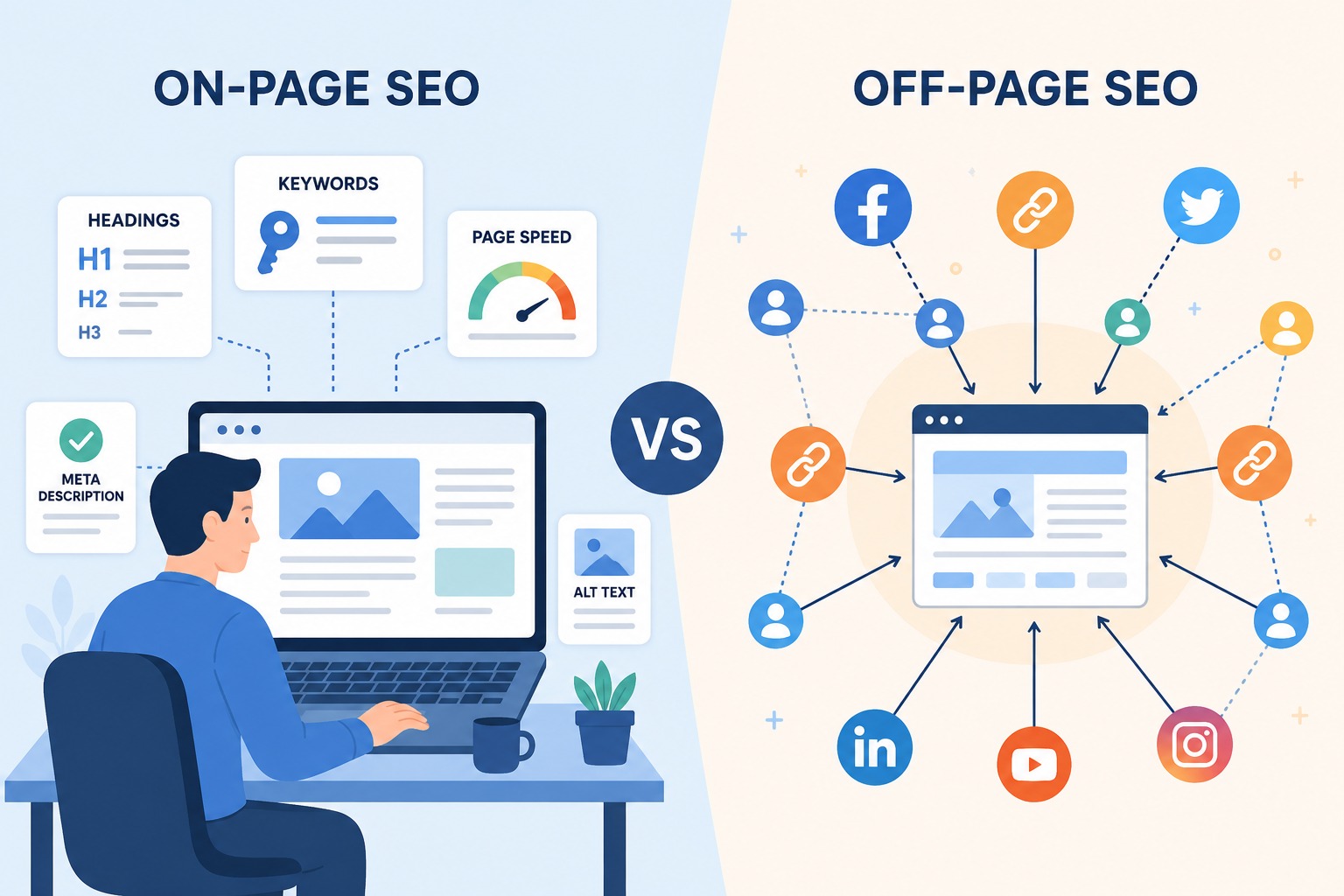
On-Page SEO vs Off-Page SEO: Difference Explained
Last week, right in the middle of a doubt-clearing session, a student stopped me and asked something pretty basic — “Sir, on-page aur off-page SEO mein farak kya hai? Dono hi toh SEO hai na, phir alag kyun bolte hain?”
I get this question a lot, honestly. Most people pick up both terms in their very first week of learning SEO. They nod, they write it down, it sounds fine in the moment. Then someone asks them to explain it back and things fall apart a bit. So let’s just go through it properly, no textbook language.
SEO Isn’t One Thing, It’s Two Halves
I usually explain it like a shop.
On-page SEO is everything happening inside the shop — how it’s arranged, whether things are easy to find, if the labels actually make sense, whether a customer can walk around without tripping over something.
Off-page SEO is what’s happening outside the shop. What people are saying about it. Whether other shopkeepers mention it to their customers. Whether it has a name for itself in the market.
Google checks both before it decides where to place you. Nail one and ignore the other, and you’re still going to be stuck somewhere on page 4.
On-Page SEO — The Part You Actually Control
This one’s simpler in a way, because it’s all stuff you can fix yourself. No outside help, no waiting on anyone.
A few things that fall under this:
Title tags and meta descriptions — do they match what’s actually on the page, and does the keyword sit there naturally?
Headings, the H1s and H2s — is there any structure, or is it just one long block of text nobody wants to read?
Keyword usage — sprinkled in where it makes sense, not crammed into every other sentence like it’s 2012.
Internal linking, so people (and Google) can move between your pages without hunting around.
Image alt text and file sizes — small thing, but it adds up.
Clean URLs instead of a random string of numbers.
Content that genuinely answers what someone typed into Google. This one matters more than people think.
Page speed and mobile experience — if it loads slow, you lose the visitor before they even read a word.
What I tell students is, on-page SEO isn’t something you do once and forget. You keep going back and tightening it as you learn more about what your audience actually wants.
Off-Page SEO — Building a Reputation Elsewhere
This is about credibility you earn outside your own website.
Backlinks are still the big one here — other sites linking back to yours. Google treats this as a trust signal, and it hasn’t really changed over the years.
Guest posting helps too, writing for other relevant blogs and picking up a link in return.
Then there’s social signals — shares, mentions, people talking about you on platforms.
Brand mentions count as well, even without a direct link. Google notices when your name keeps popping up.
Working with influencers or people who already have some authority in your space.
And for local businesses specifically, getting listed consistently across directories matters a lot.
Now here’s the honest bit — off-page SEO is slower. You can’t really rush it, and you definitely can’t fully control it. One backlink from some spammy, low-quality site can actually hurt more than it helps. So quality wins over quantity, every single time.
Why Skipping Either One Doesn’t Work
I’ve watched students mess this up both ways.
One student spent close to three months purely chasing backlinks. Nothing moved. Turned out his website had thin content and a homepage that took forever to load. There was nothing solid for the off-page work to support.
Another one did the opposite — every page was clean, keywords placed well, site loading fast. But not a single mention anywhere outside. So he had a great website that basically nobody outside his own circle knew existed.
On-page gets you ready to rank. Off-page is what actually gets you noticed enough to rank.
An Easy Way to Remember It
On-page is what Google reads on your page.
Off-page is what the rest of the internet says about your page.
Both feed into the same ranking decision, and neither one really works well on its own.
So Where Should a Beginner Start?
Fix your on-page SEO first. It’s in your hands, it’s measurable, and it gives you something to build on. Once your pages are actually useful and well put together, off-page stuff like backlinks and guest posts start working properly — because now there’s something worth linking to in the first place.
If you want to learn this hands-on instead of just reading about it, this is exactly what we walk through step by step in our SEO training at AIMS.