
AI Tools for Digital Marketers What You Actually Need in 2026
A student in one of our batches asked me something last week. “Sir, do I even need to learn manual SEO anymore? AI does everything now, right?”
Fair question. And the honest answer is no, AI doesn’t do everything. But it does change what a digital marketer’s day actually looks like. If you’re not using the right AI tools in 2026, you’re not falling behind because you lack talent. You’re falling behind because you’re doing manually what everyone else has already automated.
So let’s go through what actually matters. Not a list of fifty random tools nobody uses. Just the ones that genuinely change your workflow.
Why This Isn’t Optional Anymore
A few years ago, AI tools felt like a nice-to-have. That’s over now. Marketers who understand how to use AI effectively are pulling ahead of those who don’t. Meanwhile, clients and employers expect faster turnaround, sharper research, and better output. AI is how that expectation gets met.
That said, here’s the part people miss. AI handles the repetitive, data-heavy work. It doesn’t replace your judgment. It doesn’t decide strategy. It doesn’t understand your brand’s actual voice unless you train it to. Think of it as a very fast assistant, not a replacement for thinking.
Content Writing and Research
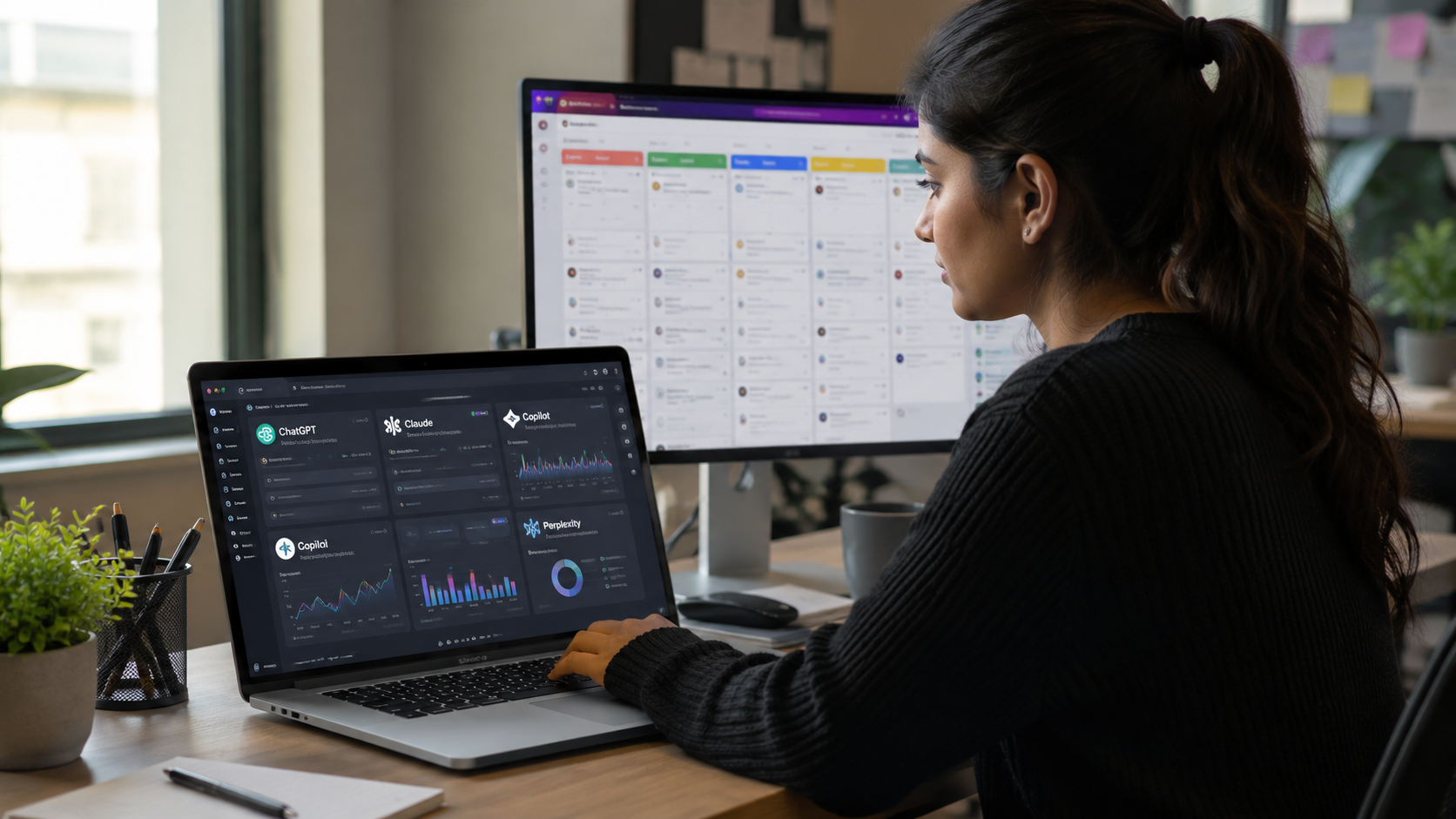
ChatGPT and Claude have become the daily starting point for most marketers. Use them for first drafts, brainstorming, ad copy, content calendars, and campaign ideas. They save hours on the blank-page problem alone.
Perplexity AI deserves a special mention here. Instead of digging through ten search results, you get a researched answer with sources attached, in seconds. For competitor research or quick fact-checking before a campaign goes live, it’s genuinely useful.
SEO and Search Intent
Surfer SEO and similar platforms combine writing and SEO into one workflow. Rather than writing content first and optimizing it later, you can do both together. This matters more in 2026 because search itself has changed. AI-generated answers now sit on top of normal search results, so understanding search intent properly has become more important, not less.
Semrush has also added AI-powered features on top of its traditional SEO toolkit. If you’re already using it for keyword tracking and competitor analysis, the AI layer adds real value without needing a separate subscription.
Ad Creative and Design
AdCreative.ai helps generate multiple ad concepts and variations quickly. If you’ve ever spent a full day manually creating five versions of the same ad for A/B testing, this cuts that time down significantly. Your creative team can then refine whichever concept tests best.
Canva’s AI features remain useful too, especially for marketers who need quick, on-brand visuals without waiting on a dedicated designer for every small request.
Video and Social Content
Invideo and similar AI video tools now support scripting, editing, voiceovers, and even music generation, all inside one workflow. Video used to be the most time-consuming content type to produce. That’s changed. A single marketer can now put together a decent short-form video without needing a full production team.
Predis.ai focuses specifically on social media content, generating captions, visuals, and post ideas from a simple prompt. Useful when you’re managing multiple client accounts and running low on fresh ideas.
What Doesn’t Change, Even With AI
Here’s the honest part most tool-lists skip. AI speeds up keyword research, first drafts, and reporting. It doesn’t replace strategy. It won’t tell you why a campaign underperformed in a way that actually makes sense for your specific business. It won’t build genuine relationships with your audience.
The marketers actually winning in 2026 aren’t the ones using the most tools. They’re the ones who let AI handle the repetitive work, and then apply real judgment on top of it. That combination is what moves results. Tools alone don’t.
Building Your Own AI Stack
You don’t need every tool on this list. In fact, trying to use all of them at once usually backfires. Pick two or three based on where you actually spend the most time. If content creation eats your day, start with ChatGPT or Claude plus Surfer SEO. If you’re managing paid campaigns, prioritize AdCreative.ai. If social media is your main workload, Predis.ai and Canva will cover most of what you need.
Test each tool for a few weeks before committing to a paid plan. Many of these platforms offer free trials, and honestly, the right combination depends heavily on your specific role and workload.
Where Most People Actually Learn This
Here’s the thing. Reading a list like this is useful, but it only gets you halfway there. Knowing a tool exists and knowing how to actually apply it inside a real campaign, for a real client, with a real budget, are two very different skills.
That’s exactly the gap we focus on closing at AIMS. Our digital marketing course doesn’t just cover the fundamentals of SEO, social media, and paid ads. It also builds in current, practical AI tool usage as part of live projects, so you’re learning on real campaigns, not just watching a demo video.
If you’re serious about staying relevant as a digital marketer in 2026 and beyond, tools alone won’t get you there. Structured learning with actual application will. Check out our Digital Marketing Course to see how we build AI skills into the curriculum, or reach out to our team if you have questions about what fits your background.